Sunday, April 14, 2013

Tuesday, March 19, 2013
2 Marriage Stories
I have a lot of mixed feelings regarding marriage. Probably because of all the marriage stories I have been told. I think I should tell two of them here. I want everybody to kind of get a feeling of where I am coming from in regards to my opinion on marriage.
The first story: A Kind of Love Story
The first story: A Kind of Love Story
Juanita "Jennie" Garcia was 33 when she got married in 1959. Even by today's standards that is "old" to get married. In the 1950s, she was nearly 13 years older than the average marrying age. From what I understand, Jennie lived a bit of a scandalous lifestyle. I won't go too much into it, but I am pretty sure that it stems from having a little bit of a scandalous family. Oh, and it can't be like 100% confirmed but I am pretty sure that Jennie was involved with Cesar Chavez's civil rights movements. But then again, that could be family legend. But back to Jennie's marriage. That is the topic of the post.
Jennie met Bill when she was 33. She had a boyfriend. She had actually been engaged more than once, and had more than one boyfriends in her lifetime. But she met Bill in the summer of 1959. He was a 21 year old freckly red-headed marine from the deep south. Jennie was a 33 year old Mexican belle of the ball from a town just north of the Mexican border. They met each other and 12 days later got married. They have been together for nearly 54 years.
Bill didn't actually know Jennie's real age until their first child was born about a year later.
Through most of their early marriage, they traveled a lot. Bill was a marine, it was kind of required. But they traveled even more than that. Beyond traveling from base to base (whether it was in North Carolina or Okinawa, Japan) with their children, or just traveling to Ireland alone together. When they settled for good, Jennie worked as an orthodontist's assistant. Bill and Jennie raised three children. They also played a part in raising a lot of Jennie's nieces and nephews as well. When their children left the house, they took care of the grandchildren. When their grandchildren grew up, Jennie took care of Bill.
Like I said, it is kind of classically romantic.
The Second Story: Kind of the Opposite of a Love Story
Kane Nunokawa was from a rural part of Japan in 1932. To give you an idea of how rural, her birthday is September 1, because she wasn't born in a hospital and her parents knew the month but had no idea of the actual date. She has lived a mostly tragic life. Her parents died in the fire bombing of Japan in WWII. Well, at least one of her parents did. Her background in general is kind of choppy. When Kane was older, she and a friend would go on the marine base to dance with the young men. It was here that Kane the only man she had ever loved. Unfortunately, he returned to Minnesota before she was ever able to be with him. Robert from Arizona was her second choice. It was a mutually beneficial. Robert gained the perfect housewife, and Kane gained a free ticket to the United States and subsequently US citizenship.
But like I said, this isn't a story of roses and love. Kane never fell in love with Robert. And Robert was never a good man. He was angry a lot and drank too much. Because of the language barrier, Kane was isolated from most of their neighbors and never quite assimilated the way that I am pretty sure that Robert would have preferred. I am actually not to sure if they ever really liked each other most of the time.
Kane and Robert had 4 children. It would have been 5, but Kane illegally aborted the first child, and nearly from it. Like Bill and Jennie, they traveled the world due to Robert's military status. When Robert retired, he got a job that required him to be gone most of the time. It was during this period that Kane attempted to run away. It didn't go well. I don't really know much about their marriage after that.
Robert died nearly 20 years ago. Too much alcohol and too many cigarettes. Kane has friends now. The other Japanese women in just north of the border Arizona.
I don't know that I have ever really seen Kane happy though. Like really happy. But she is kind of hard to read.
Jennie met Bill when she was 33. She had a boyfriend. She had actually been engaged more than once, and had more than one boyfriends in her lifetime. But she met Bill in the summer of 1959. He was a 21 year old freckly red-headed marine from the deep south. Jennie was a 33 year old Mexican belle of the ball from a town just north of the Mexican border. They met each other and 12 days later got married. They have been together for nearly 54 years.
Bill didn't actually know Jennie's real age until their first child was born about a year later.
Through most of their early marriage, they traveled a lot. Bill was a marine, it was kind of required. But they traveled even more than that. Beyond traveling from base to base (whether it was in North Carolina or Okinawa, Japan) with their children, or just traveling to Ireland alone together. When they settled for good, Jennie worked as an orthodontist's assistant. Bill and Jennie raised three children. They also played a part in raising a lot of Jennie's nieces and nephews as well. When their children left the house, they took care of the grandchildren. When their grandchildren grew up, Jennie took care of Bill.
Like I said, it is kind of classically romantic.
The Second Story: Kind of the Opposite of a Love Story
Kane Nunokawa was from a rural part of Japan in 1932. To give you an idea of how rural, her birthday is September 1, because she wasn't born in a hospital and her parents knew the month but had no idea of the actual date. She has lived a mostly tragic life. Her parents died in the fire bombing of Japan in WWII. Well, at least one of her parents did. Her background in general is kind of choppy. When Kane was older, she and a friend would go on the marine base to dance with the young men. It was here that Kane the only man she had ever loved. Unfortunately, he returned to Minnesota before she was ever able to be with him. Robert from Arizona was her second choice. It was a mutually beneficial. Robert gained the perfect housewife, and Kane gained a free ticket to the United States and subsequently US citizenship.
But like I said, this isn't a story of roses and love. Kane never fell in love with Robert. And Robert was never a good man. He was angry a lot and drank too much. Because of the language barrier, Kane was isolated from most of their neighbors and never quite assimilated the way that I am pretty sure that Robert would have preferred. I am actually not to sure if they ever really liked each other most of the time.
Kane and Robert had 4 children. It would have been 5, but Kane illegally aborted the first child, and nearly from it. Like Bill and Jennie, they traveled the world due to Robert's military status. When Robert retired, he got a job that required him to be gone most of the time. It was during this period that Kane attempted to run away. It didn't go well. I don't really know much about their marriage after that.
Robert died nearly 20 years ago. Too much alcohol and too many cigarettes. Kane has friends now. The other Japanese women in just north of the border Arizona.
I don't know that I have ever really seen Kane happy though. Like really happy. But she is kind of hard to read.
Tuesday, March 12, 2013
I’m not a real woman…I’m a shark!
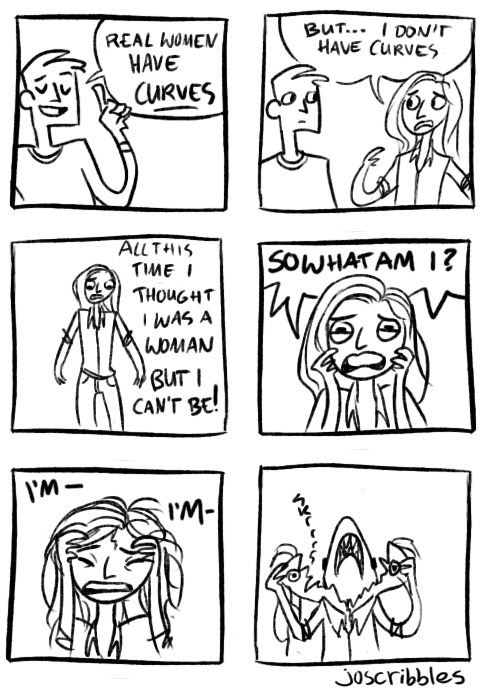
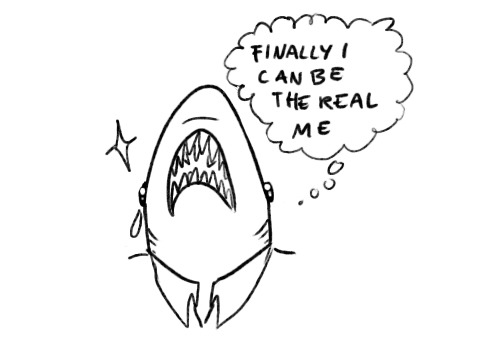
From: http://wealldraw.tumblr.com/post/42848072260/real-women-have-curves-real-sharks-disguise
This cartoon made me laugh out loud. Because, as we know,
everything dealing with sharks is super hilarious. I swear, just add in a shark
to something unexpected and it instantly becomes a major point of hilarity. This hasn't been statistically proven, so I think that I should probably write a grant to get that funded. Then all I would have to do is look at shark comics all day.
But the main reason I like this comic isn't for the shark, it is for the message. I am pretty sure I just phrased that in the lamest way possible, but it is true. Women are told they have to adhere to a specific image. And if they don't adhere to this image then there is something wrong with them, and more likely than not, it isn't them secretly being a shark.
This is the video that we watched in class. And what I enjoy about this movie is that it points out the severe disconnect about what women are supposed to look like according to the media and what women are actually able to look like. But most specifically, it points out how all these contrasting notions of a woman's beauty are largely created by men. Women aren't supposed to look good for themselves, they are supposed to look good for men. And if they can't achieve that naturally, well, then, they are going to have to buy it. Everything in the world comes back to money and the cosmetic industry is a multi-billion dollar industry. That is billion, with a "b" in case you misread that. And if you think that you avoid that industry think again. I mean, I know that I probably spend greater than $200 a year on haircuts alone.
But you can see the harm of this ideal body image created by the media everyday. Or at least I see it everyday. Especially as spring break approaches. Most residents in my hall are stressing about their diet and their figures because they are going to the beach. They want to do Insanity three times a week. I get wanting to be fit and healthy, but things like Insanity or P90X are just crazy to me. Also, wanting your body to be perfect for the beach is just feeding into the power of the male gaze. You aren't really doing it for yourself (and if you are, that's awesome! but trust me, my residents aren't), and you certainly aren't doing it for your friends (and if you are, your friends blow, find some new ones because I know that my friends would never pressure me to change my body), which means you have to be doing it in order to be seen as sexually attractive. Like I mentioned, there is nothing wrong with wanting to look good, but make sure you do it for you? Because if you always have to look your best for somebody to want you then what is the point? That is too much time, money, and effort spend in conforming yourself.
But the main reason I like this comic isn't for the shark, it is for the message. I am pretty sure I just phrased that in the lamest way possible, but it is true. Women are told they have to adhere to a specific image. And if they don't adhere to this image then there is something wrong with them, and more likely than not, it isn't them secretly being a shark.
This is the video that we watched in class. And what I enjoy about this movie is that it points out the severe disconnect about what women are supposed to look like according to the media and what women are actually able to look like. But most specifically, it points out how all these contrasting notions of a woman's beauty are largely created by men. Women aren't supposed to look good for themselves, they are supposed to look good for men. And if they can't achieve that naturally, well, then, they are going to have to buy it. Everything in the world comes back to money and the cosmetic industry is a multi-billion dollar industry. That is billion, with a "b" in case you misread that. And if you think that you avoid that industry think again. I mean, I know that I probably spend greater than $200 a year on haircuts alone.
But you can see the harm of this ideal body image created by the media everyday. Or at least I see it everyday. Especially as spring break approaches. Most residents in my hall are stressing about their diet and their figures because they are going to the beach. They want to do Insanity three times a week. I get wanting to be fit and healthy, but things like Insanity or P90X are just crazy to me. Also, wanting your body to be perfect for the beach is just feeding into the power of the male gaze. You aren't really doing it for yourself (and if you are, that's awesome! but trust me, my residents aren't), and you certainly aren't doing it for your friends (and if you are, your friends blow, find some new ones because I know that my friends would never pressure me to change my body), which means you have to be doing it in order to be seen as sexually attractive. Like I mentioned, there is nothing wrong with wanting to look good, but make sure you do it for you? Because if you always have to look your best for somebody to want you then what is the point? That is too much time, money, and effort spend in conforming yourself.
Monday, March 11, 2013
Tropes vs. Women in Video Games from Feminist Frequency
I am in the process of writing a blog post about body image, but for now, here is a topic that I am a little bit more excited about. I will add my own two cents in later, but for right now I just waned to share the video. You can find the rest of Anita Sarkeesian's videos here but her Tropes vs. Women in Video Games has just started.
Here is the first of the series:
The Disney Princess Culture

There is a documentary out there called Mickey Mouse Monopoly, and I am going to write about it so you don't have to watch it. It isn't that I found the movie incredibly offensive (I didn't) or that it wasn't making good points (because it was), but rather, it was filmed very poorly. If I wanted to point to one movie whose message was almost destroyed by the quality of the film making, this is the movie to which I would point. But this isn't a blog about cinematography, so I will proceed with only making one note on how the zoom function on the camera was basically abused. So keep that in mind, filmmakers of the future. Closeups are not always your friend.
But cinematic criticism aside, this documentary made some good points. While I will admit they weren't my favorite points, and would have been strengthened given a more objective point of view (you could practically smell the bias coming off this movie, and it just felt like one of the subjects had a personal vendetta against Disney). I swear that is my last criticism that I will level against the documentary as a film. Obviously, the movie concentrated on how Disney owns a lot of the media, which is true, and how that is not necessarily a good thing. Because Disney's main goal is to make a bunch of money. But I am not going to talk about that. That is a post for a different blog on a different day. I am here to specifically discuss the criticism leveled at the whole "Disney Princess" culture.
 From: http://thenewinquiry.com/essays/just-another-princess-movie/
Image by Imp Kerr
In short, the film argued about the harm and negative reinforcement of gender stereotypes that is caused by the Disney Princesses. Looking back at all my favorite Disney films (including Pixar in this too), my favorite movies have never been the "princess" movies (my childhood favorite was Toy Story but in contrast, my younger brother's childhood favorite was Cinderella). I think that the early ones are all works of art (really, they are just stunning) but the characters fall flat (universally, pretty much, not just on the women's side). But the early Disney princess movies (think Cinderella, Snow White, and Sleeping Beauty) pretty much fall into the pitfalls of their time. Women in these movies are meant to be saved by men. And they pretty much rely on their beauty for that to happen. Like I said, pitfalls of the time period in which they were made in. You can't expect some kind of deviance from this because Disney isn't really out to make a statement. I will give all these movies a pass because I am pretty sure that eventually everybody learns that the times have changed.
Now things are a little different, and I think that you see that with the most recent Disney princess movies: Tangled, The Princess and the Frog, and Mulan. I will even add the 90s princesses into the mix as well (although Jasmine should be considered separately because the movie was not about her). You see a shift from characters being driven by beauty and love to being driven by motivations of their own. Rapunzel wants to escape the castle, Tiana wants to own a restaurant, Mulan wants to fight for her family, Jasmine wants to escape the palace walls, Belle wants to leave a life of monotony, etc. Even Ariel wasn't motivated by Prince Eric, she just wanted to walk on land. Do the stereotypes exist? Yes they do. But as the movies continue to be made, they exist to a much lesser degree. Which isn't something to necessarily be praised for (It's like "yay you are less sexist than you were in the past!") but it is something to be noted. I would still like to see more change being made, but it's a start. And hey, there is always Pixar (which gets really into making statements...aside from Cars).
By all accounts though this should be expected. By creating a princess culture, Disney has basically created a giant pot of money on which it can always rely upon to exist. I think that this is more harmful than any movie. Because the princess culture is what perpetuates the importance of beauty, not the actual movies themselves. And by doing this it can sell dolls, makeup, dresses, costumes, and other various toys. Disney convinces children to buy their toys and at the same time convinces them that all they need in life are beauty and true love to get by. It's a business model that works but not a business model that is the best from a stereotype perspective. Unfortunately I don't see this changing anytime soon. As long as Disney is making loads of money, why should it change?
In the interest of words, I will leave it here, but at another time I will definitely discuss what modern animated films have defined as a woman's place in the world is under a different perspective. And not just through a business model.
But cinematic criticism aside, this documentary made some good points. While I will admit they weren't my favorite points, and would have been strengthened given a more objective point of view (you could practically smell the bias coming off this movie, and it just felt like one of the subjects had a personal vendetta against Disney). I swear that is my last criticism that I will level against the documentary as a film. Obviously, the movie concentrated on how Disney owns a lot of the media, which is true, and how that is not necessarily a good thing. Because Disney's main goal is to make a bunch of money. But I am not going to talk about that. That is a post for a different blog on a different day. I am here to specifically discuss the criticism leveled at the whole "Disney Princess" culture.

Image by Imp Kerr
In short, the film argued about the harm and negative reinforcement of gender stereotypes that is caused by the Disney Princesses. Looking back at all my favorite Disney films (including Pixar in this too), my favorite movies have never been the "princess" movies (my childhood favorite was Toy Story but in contrast, my younger brother's childhood favorite was Cinderella). I think that the early ones are all works of art (really, they are just stunning) but the characters fall flat (universally, pretty much, not just on the women's side). But the early Disney princess movies (think Cinderella, Snow White, and Sleeping Beauty) pretty much fall into the pitfalls of their time. Women in these movies are meant to be saved by men. And they pretty much rely on their beauty for that to happen. Like I said, pitfalls of the time period in which they were made in. You can't expect some kind of deviance from this because Disney isn't really out to make a statement. I will give all these movies a pass because I am pretty sure that eventually everybody learns that the times have changed.
Now things are a little different, and I think that you see that with the most recent Disney princess movies: Tangled, The Princess and the Frog, and Mulan. I will even add the 90s princesses into the mix as well (although Jasmine should be considered separately because the movie was not about her). You see a shift from characters being driven by beauty and love to being driven by motivations of their own. Rapunzel wants to escape the castle, Tiana wants to own a restaurant, Mulan wants to fight for her family, Jasmine wants to escape the palace walls, Belle wants to leave a life of monotony, etc. Even Ariel wasn't motivated by Prince Eric, she just wanted to walk on land. Do the stereotypes exist? Yes they do. But as the movies continue to be made, they exist to a much lesser degree. Which isn't something to necessarily be praised for (It's like "yay you are less sexist than you were in the past!") but it is something to be noted. I would still like to see more change being made, but it's a start. And hey, there is always Pixar (which gets really into making statements...aside from Cars).
By all accounts though this should be expected. By creating a princess culture, Disney has basically created a giant pot of money on which it can always rely upon to exist. I think that this is more harmful than any movie. Because the princess culture is what perpetuates the importance of beauty, not the actual movies themselves. And by doing this it can sell dolls, makeup, dresses, costumes, and other various toys. Disney convinces children to buy their toys and at the same time convinces them that all they need in life are beauty and true love to get by. It's a business model that works but not a business model that is the best from a stereotype perspective. Unfortunately I don't see this changing anytime soon. As long as Disney is making loads of money, why should it change?
In the interest of words, I will leave it here, but at another time I will definitely discuss what modern animated films have defined as a woman's place in the world is under a different perspective. And not just through a business model.
Monday, March 4, 2013
The Persisting Fag Culture

Reading CJ Pascoe's Dude You're a Fag made me think a lot. In high school, I hung out with the theatre kids most of the time. They were just my crowd. And like the theatre kids in the book, I was pretty isolated from the "fag culture" that pervades a lot of high school. As I was reading the book, I was a little appalled at the behavior described and I was appalled by the behavior that teachers just allowed. But as I was reading it, I could imagine that if my high school experience wasn't so isolated from the normal high school crowd, if I didn't spend my time in the "smart" classes or if my extracurriculars consisted of more than theatre, math club, and scholar bowl, that I would have easily seen this kind of behavior. I would have been more exposed to the culture that Pascoe described.
But as I was reading, the one place that it really stood out to me is the residence hall I live in. Pascoe mentioned that females didn't carry out the fag discourse as often as males did, so it is a little surprising that where I see this behavior the most often is the all female dorm. And it is used very much in the same way. It isn't ever thrown at one resident to another, but most often it is used by the female residents when males come to visit. When a male jokingly imitates stereotypical behavior or hangs around like a love sick puppy dog, you can hear down the hallway "You're such a fag." Whenever, I am around, I attempt to stop this language (something that is very ingrained into us during our 1 week of intensive training), but it always strikes me as odd. I hear "fag" used offensively way more than I hear "gay" used offensively which really surprises me.
It goes back to what Pascoe said, it wasn't about being homosexual, it was about masculinity. Being called a "fag" reflects a loss of masculinity. As she says, you can still be gay and masculine (as one boy said, it doesn't stop you from being able to throw a football), but it is that loss of masculinity which really drives the fag discourse.
Again as much as I am surprised, at the very same time I am not. Most of these women were popular in high school. The students that they hung out with weren't the theatre kids, they were the jocks. They were the cheerleaders and they were the popular kids. In a way, they were the ones that most adhered to the stereotypical norms in regards to gender. It shouldn't surprise me that they enforce this idea of masculinity that arises from high school. I think what surprises me most is that I didn't see this around me until my senior year of college. Because there is no way that it hadn't been happening before.
Anyway, if you get a chance, I would recommend Dude You're a Fag, I might reference that book again sometime later (especially the chapter regarding female masculinity, which probably resonated with me the most), but for now this is all I have regarding it. Except, I will say, I wish that maybe she had talked a little bit more about how women partake in the fag discourse. I believe she mentioned that women were not nearly as involved in it, but at the same time, through my own observations, women are as embedded in the fag discourse as men. It would be interesting to observe how different women see and partake in the discourse.
Sunday, February 17, 2013
Wonder Woman...Or Why It Is Rough to Be a Woman Heroine

Let's start with some bare bones things first. I am a Marvel person. The majority of their media (that is comics, television, movies, etc.) just tends to resonate with me more. Possibly due to the fact that I feel that Marvel handles its social justice issues with such aplomb. I mean, I will admit that the DC does animation better (I am pretty sure that anything in the DC Animated Universe could qualify as top cartoonage) but on the whole I tend to be a Marvel girl. I say this because I want to lay all my biases out in case at any point I seem unnecessarily rough on Wonder Woman.
But there is no denying that Wonder Woman is an icon. She was really the first female superhero. She became a staple of the feminist movement. Never mind that her story nowadays does not reflect her early female empowerment vibes that she embodied (really, it sucks right now), but there is no denying that Wonder Woman changed the presence that women, especially women that took action, had in pop culture.
I start off with Wonder Woman because she is the most iconic, but what I really want to do is change it to somebody else. Or multiple somebodies. This whole blogging thing is more free form thing rather than a thought out thing, like stream of consciousness and what not.
First I want to move onto Sarah Connor, Ellen Ripley, and Clarice Starling. If you don't remember what they look like, here they are:


Sorry for the crappy image embedding, I never claimed to be like excellent with formatting. Maybe that is something I can learn as this blog progresses, and in the end I can just be like "LOL REMEMBER WHEN MY PICTURES SUCKED?" But that is not the point.
Getting back to Sarah Connor, Ellen Ripley, and Clarice Starling. I chose these three women because I really believe that they were some of the first of their kind in regards to portrayal of women as heroines in pop culture. Of course, Ellen Ripley came first and then Sarah Connor and Clarice Starling (well, Clarice is based off the book character, but I am not going to look that up because I think that the movie image is most resonating and familiar to most casual people). But just look at them. They aren't sexual objects and they just look like they are going to fuck shit up. It just isn't something that you see as much. But when your current default action heroine is Angelina Jolie, what the fuck do you expect? Sometime after Jodie Foster, Sigourney Weaver, and Linda Hamilton the action heroine turned into this:


I mean, Milla Jovovich is fighting zombies in a dress. Angelina Jolie's outfit is all about the breasts. You get skintight and form fitting instead of the loose functionality and practicality of the previous women's outfits. Or you get the most ridiculous of all:

I mean, how is exposed cleavage functional for battle? I mean, the answer is that it isn't, exposed cleavage is only useful for drawing more heterosexual men to the movie theaters.
I think this begs the question: why are action movies geared towards men? And why do women have to suffer or be sexualized because of it? Is an explosion not as cool if Megan Fox isn't running away from it in cutoff Daisy Dukes? If you can't see every contour of Angelina Jolie's breasts and thighs as she is tomb raiding, does it make her less of a tomb raider? I mean, to mean it seems like having pants would be more ideal. Because who knows what kind of weird jungle pants you are going to run your legs through. And for the record, I am pretty sure that most male explorer/grave robbers/action heroes wear pants (even though I am sure that most women might not mind seeing action hero thighs on display). I mean, Samus Aran's Zero Suit at least has functionality (and let's not forget that the majority of the time she is wearing the power armor:

If you type in female action movies into Google, I don't think you come up with a lot. There are very few action movies driven by women, and fewer which could be considered good movies. TV I think fares a little better and video games are almost dismal. I mean, I am looking at IMDB's list of Top 50 Action Females, and it stretches to include Keira Knightly...for Pirates of the Caribbean and Anne Hathaway for Get Smart (granted she is now Catwoman so that is like tons better). That's how dismal it is. Gone is the day of Linda Hamilton, Sigourney Weaver, Jodie Foster, Lynda Carter, Lucy Lawless, and Pam Grier. Even Ziyi Zhang (#never4get House of Flying Daggers and Crouching Tiger, Hidden Dragon). In are the Milla Jovovich's, the Kate Beckinsale's and the Angelina Jolie's. Because for some reason directors have it in their heads that woman need to be fetishized in action movies in order to be appealing to men.
Of course this is a gross over generalization, and I openly acknowledge that. So to leave off on a good note, here is Uma Thurman with blood all over face. Because this entire post has put me in the mood to watch some Kill Bill and love on Quentin Tarantino.

I start off with Wonder Woman because she is the most iconic, but what I really want to do is change it to somebody else. Or multiple somebodies. This whole blogging thing is more free form thing rather than a thought out thing, like stream of consciousness and what not.
First I want to move onto Sarah Connor, Ellen Ripley, and Clarice Starling. If you don't remember what they look like, here they are:


Getting back to Sarah Connor, Ellen Ripley, and Clarice Starling. I chose these three women because I really believe that they were some of the first of their kind in regards to portrayal of women as heroines in pop culture. Of course, Ellen Ripley came first and then Sarah Connor and Clarice Starling (well, Clarice is based off the book character, but I am not going to look that up because I think that the movie image is most resonating and familiar to most casual people). But just look at them. They aren't sexual objects and they just look like they are going to fuck shit up. It just isn't something that you see as much. But when your current default action heroine is Angelina Jolie, what the fuck do you expect? Sometime after Jodie Foster, Sigourney Weaver, and Linda Hamilton the action heroine turned into this:

I mean, Milla Jovovich is fighting zombies in a dress. Angelina Jolie's outfit is all about the breasts. You get skintight and form fitting instead of the loose functionality and practicality of the previous women's outfits. Or you get the most ridiculous of all:

I mean, how is exposed cleavage functional for battle? I mean, the answer is that it isn't, exposed cleavage is only useful for drawing more heterosexual men to the movie theaters.
I think this begs the question: why are action movies geared towards men? And why do women have to suffer or be sexualized because of it? Is an explosion not as cool if Megan Fox isn't running away from it in cutoff Daisy Dukes? If you can't see every contour of Angelina Jolie's breasts and thighs as she is tomb raiding, does it make her less of a tomb raider? I mean, to mean it seems like having pants would be more ideal. Because who knows what kind of weird jungle pants you are going to run your legs through. And for the record, I am pretty sure that most male explorer/grave robbers/action heroes wear pants (even though I am sure that most women might not mind seeing action hero thighs on display). I mean, Samus Aran's Zero Suit at least has functionality (and let's not forget that the majority of the time she is wearing the power armor:

I know that originally she wore like a bikini, but I am willing to put that more on video game design technology of the day than sexism (I mean, there was probably a lot of gender stereotyping there, but again, for the reveal of Samus being a woman to be most effective she had to be obviously a woman, which brings up a lot of other issues).
If you type in female action movies into Google, I don't think you come up with a lot. There are very few action movies driven by women, and fewer which could be considered good movies. TV I think fares a little better and video games are almost dismal. I mean, I am looking at IMDB's list of Top 50 Action Females, and it stretches to include Keira Knightly...for Pirates of the Caribbean and Anne Hathaway for Get Smart (granted she is now Catwoman so that is like tons better). That's how dismal it is. Gone is the day of Linda Hamilton, Sigourney Weaver, Jodie Foster, Lynda Carter, Lucy Lawless, and Pam Grier. Even Ziyi Zhang (#never4get House of Flying Daggers and Crouching Tiger, Hidden Dragon). In are the Milla Jovovich's, the Kate Beckinsale's and the Angelina Jolie's. Because for some reason directors have it in their heads that woman need to be fetishized in action movies in order to be appealing to men.
Of course this is a gross over generalization, and I openly acknowledge that. So to leave off on a good note, here is Uma Thurman with blood all over face. Because this entire post has put me in the mood to watch some Kill Bill and love on Quentin Tarantino.

Subscribe to:
Posts (Atom)